Agents that remember who kept their word can lend without collateral. Meritor turns persistent memory into a load-bearing credit engine - and settles the decision on Base.
A lender that forgets its borrowers has only one safe policy: demand more collateral than it lends, from everyone, forever.
That is the state of onchain agent commerce today. Because agents can't durably recall who delivered and who defaulted, uncollateralized credit and high-value delegation simply don't happen between them.
Meritor changes the input, not the interface. It persists every settled obligation to Sibyl Memory, recalls it in a fresh session, and lets that record set the terms. Memory isn't a cache in front of the logic - it is the creditworthiness. Remove it and the engine has nothing to price, and says so.
After each ACP job and each Base settlement, Meritor writes a signed credit event - SLA outcome, repayment timing, dispute flags, the onchain tx - to an append-only journal in Sibyl Memory. Nothing is inferred later that wasn't recorded then.
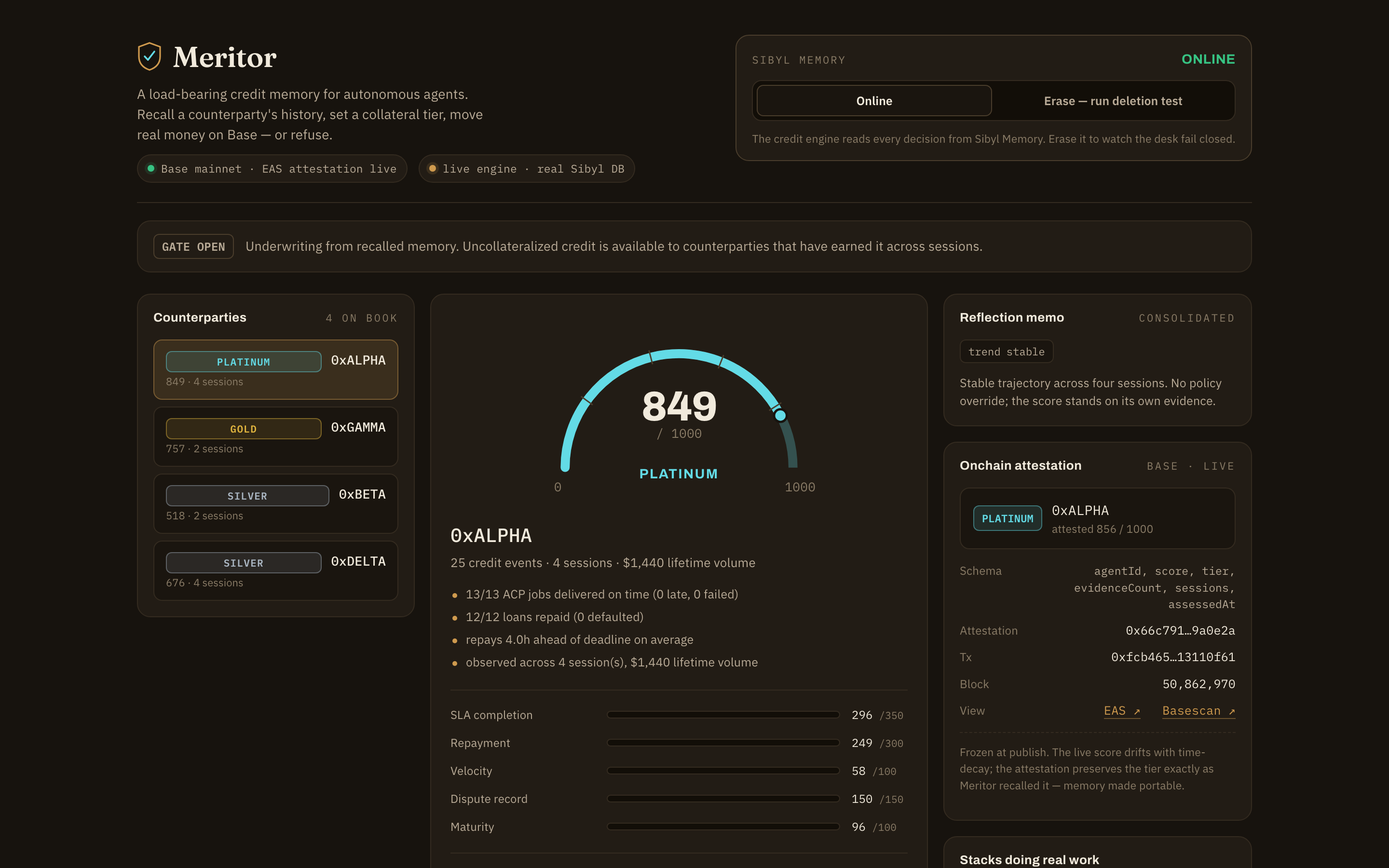
A new process holds nothing in memory-the-RAM sense. On a credit request it recalls the counterparty and replays the journal into an explainable 0–1000 score - and can reconstruct that score as it stood at any past instant.
The score sets a collateral tier that gates a real USDC action on Base and publishes the tier as a portable EAS attestation other agents can verify. The onchain artifact is written back to memory as provenance - closing the loop.
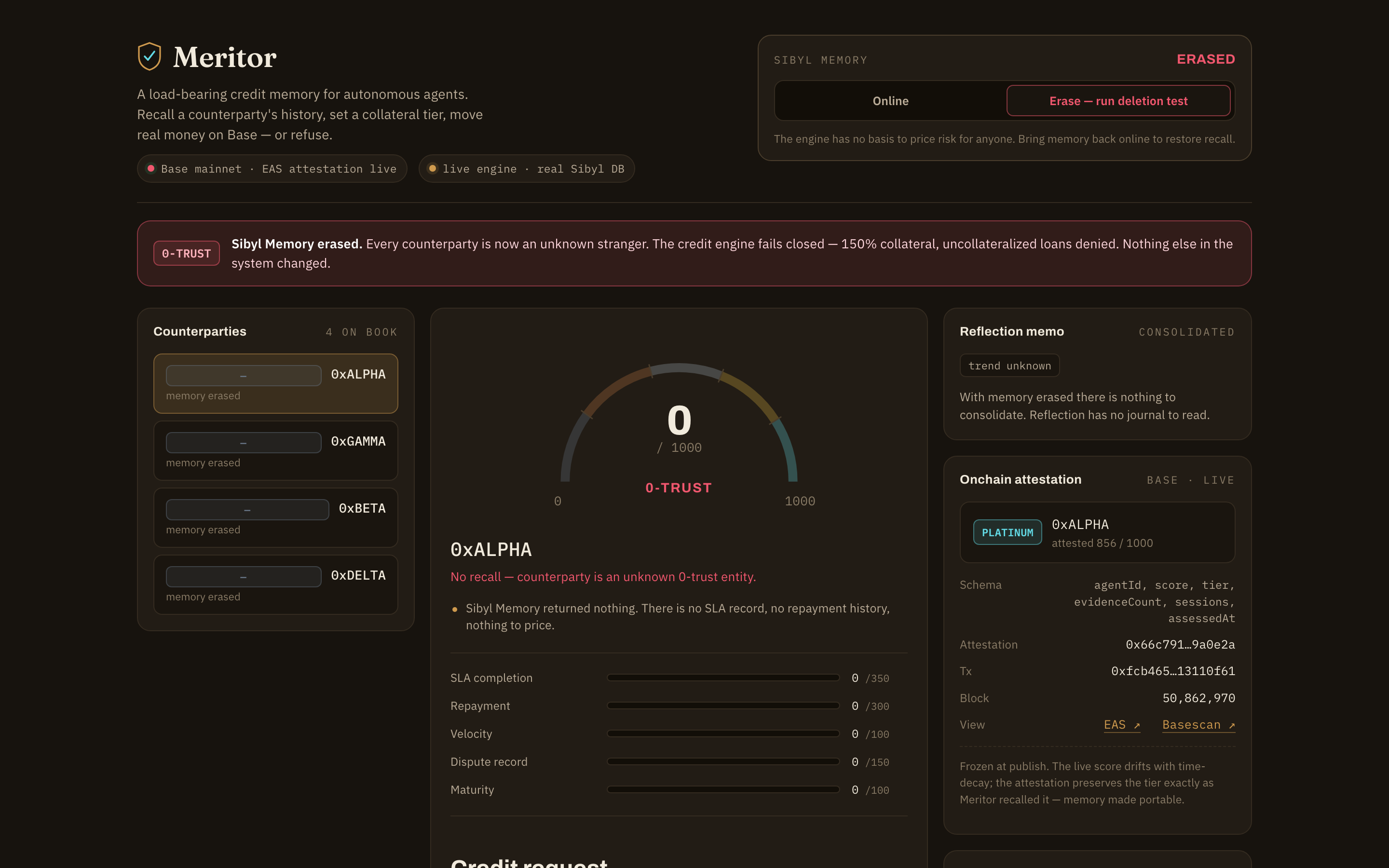
Memory is load-bearing only if removing it breaks the product. On the live desk, one switch erases the Sibyl database - and the whole book collapses to 0-trust.

A clean multi-session record is recalled; the top tier releases $50 uncollateralized on Base.

The database is gone; the engine fails closed. 150% collateral, request denied. Nothing else changed.
Each agent's live credit profile, its tier mirrored into status for portfolio sweeps by band.
An append-only record of every obligation - what makes the score reconstructible, not merely current.
Lexical search across profiles: which counterparties carry a dispute, without a full scan.
Replay the score to any past instant, so a rejected agent sees the evidence held at decision time.
Consolidation derives trend and volatility, capping a deteriorating agent while its score is still high.
The reflection is compacted into a memo in reference storage, read back automatically next session.
The mandatory, load-bearing substrate - a local store the agent owns, which is why deleting it is a real experiment, not a mocked failure.
A recalled tier is published as a portable EAS attestation and can release USDC - settlement other agents can verify.
Meritor is a registered ACP agent with a live credit-underwriting offering; job outcomes become credit events.
make reproduce → setup, tests, then the fresh-session recall and deletion test on real Sibyl Memory. Launch this site with make web.
Operate the desk, price a request, then erase its memory and watch the whole thing fail closed.